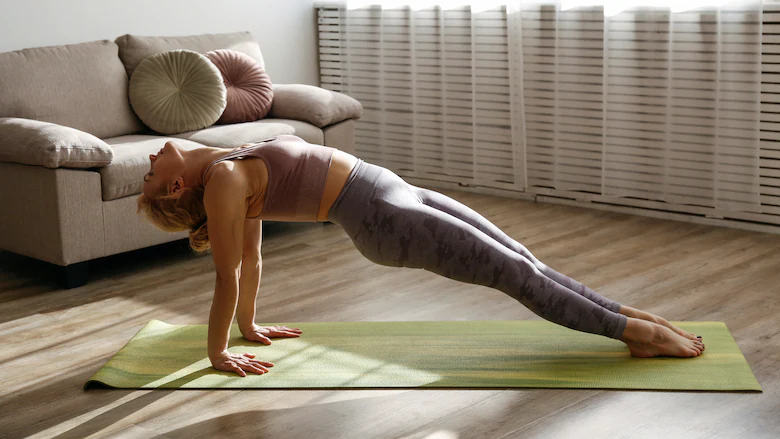
Are push-ups, crunches, and the classic plank already familiar to you? Then it’s time to try a new exercise: the reverse plank! Instead of supporting yourself on your forearms and staring at the floor as in a regular plank, you lift your body into a straight line and look upwards. This exercise activates numerous muscle groups and adds a fresh twist to your workout.
Benefits of the daily reverse plank
The reverse plank has many positive effects on your body. In particular, it strengthens the posterior chain – that is, the shoulder blades, triceps, and glutes. According to Markus Bremen, personal trainer and certified sports scientist, the reverse plank promotes an upright posture and strengthens the upper back and glutes.
For people who sit a lot or suffer from back pain, the reverse plank can work wonders. It helps correct postural problems and relieve strain on the back muscles. Another benefit: it also trains the abdominal muscles, leading to improved core stability.

Step-by-step instructions for reverse planks
- Sit on the floor with your legs extended. Place your hands slightly to the sides behind your upper body.
- Tense your upper body and push your arms upwards until they are straight.
- Lift your hips and sternum so that your body forms a straight line; your head and neck should also remain in this line.
- Hold this position for up to 30 seconds, then slowly lower yourself back down.
Repeat this three times. To make the exercise more challenging, you can alternate lifting your legs. For an easier version, perform the exercise on your forearms instead of with straight arms.

Two common mistakes in reverse plank training
There are two common mistakes you should definitely avoid when performing the reverse plank:

- Hip posture: Your body should form a straight line. If you raise or lower your hips too much, you can develop an arched back, which leads to back pain.
- Head posture: Your head should always be straight, as a direct extension of your spine. Otherwise, you may experience tension in your neck.
Conclusion: Reverse plank – A worthwhile addition to your training
The reverse plank is a valuable exercise for any workout. It strengthens the posterior chain, improves posture, and simultaneously works the abdominal muscles. Daily practice can correct postural problems and alleviate back pain. Pay attention to proper form and avoid common mistakes to get the most out of this exercise. Start today and take your training to the next level.