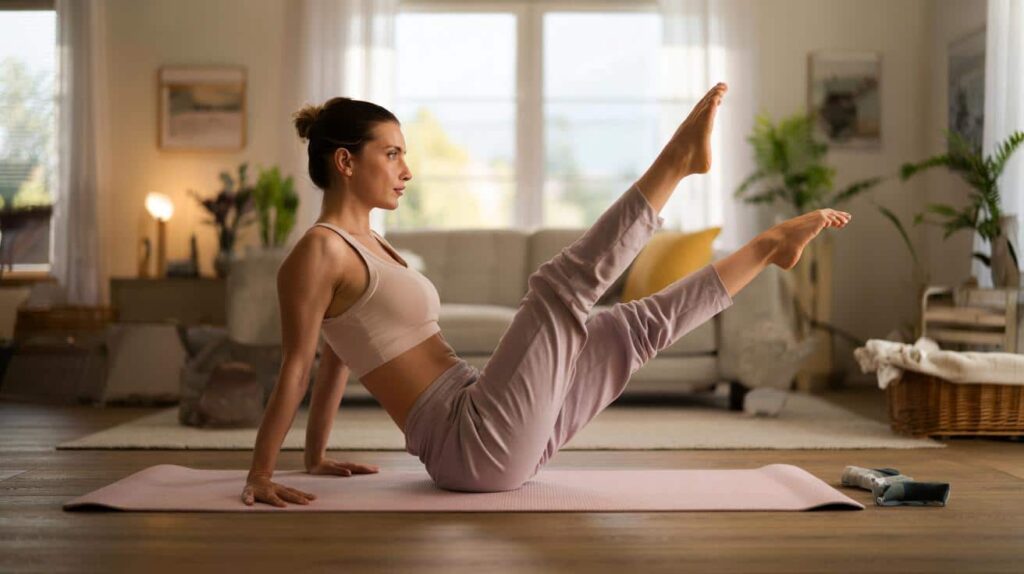
Anyone who zips up their jeans after work and notices their belly protruding knows the frustrating feeling. Instead of endless crunches that mainly strain the neck, an experienced Pilates instructor recommends a short but targeted sequence for home use. With this routine, the stomach and waist should feel noticeably firmer within about three weeks – no gym, no equipment, no hardcore workout.
Why Pilates tones the stomach without straining the neck and back
Many people intuitively resort to sit-ups and crunches in classic abdominal training. The problem is that these exercises heavily engage the neck, upper back, and often only the superficial abdominal muscles. The deep core muscles around the waist are frequently neglected.
This is precisely where Pilates comes in. The method combines controlled breathing, precise body alignment, and conscious activation of the deep abdominal muscles. These muscles act like an internal corset, stabilizing the waist from within.
The core of the method: first activate the deep abdominal muscles, then move – this way the whole torso works, not just the visible “six-pack” muscles.

Those who train like this regularly usually notice three effects:
- The stomach appears flatter because the deep muscles provide better support.
- The posture straightens, shoulders and pelvis come into a line,
- The back and neck are relieved because the torso provides more stable support.
Many Pilates coaches emphasize that it’s not about maximum effort, but about control. Those who use their exhalation, gently draw their abdomen inwards, and keep their pelvis stable, get more out of each individual repetition than with a hundred hasty crunches.
The 5 Pilates exercises that the coach recommends for a flat stomach
The routine put together by the trainer consists of five classics from the Pilates repertoire. All exercises can be performed on a mat or carpet in the living room.
Single leg stretch – the basis for the deep core
Starting position: Lie on your back, bring your legs into the table position one at a time (hips and knees bent at approximately 90 degrees). Lift your upper body slightly, support one leg with your hands, and extend the other leg forward.
Then alternate legs in a rhythmic tempo. One leg is drawn towards the chest, the other is extended far forward, without arching the lower back. Each leg change is synchronized with the breath – inhaling when switching legs, exhaling when drawing the leg in.
Double leg stretch – more of a challenge for the entire abdominal wall
The starting position is similar to the single leg stretch, except that both knees are pulled towards the chest simultaneously. From there, arms and legs extend diagonally forward at the same time, while the torso remains stable.
As you exhale, return your arms and legs to the center. Keep your abdomen drawn in throughout the movement, and your lower back firmly on the floor.
Double leg lower lifts – focus on the lower abdomen
This variation specifically targets the area many refer to as the „problem area of the lower abdomen.“ Both legs are stretched upwards; the upper body can be slightly raised, but this is not necessary.
As you exhale, stabilize your abdomen, then slowly lower both legs towards the floor – only far enough to prevent your back from arching. Then, in a controlled manner, raise your legs back up.
Shoulder bridge with kick – connection of buttocks, back and abdomen
For this exercise, lie on your back with your feet hip-width apart and your arms at your sides. As you exhale, roll your pelvis upwards, vertebra by vertebra, until your shoulders, pelvis, and knees form a diagonal line.
While holding the „bridge“ position, extend one leg upwards towards the ceiling. Then, kick this leg forwards in a controlled manner and back again. Repeat on the other side.

Scissors – Stretching and strength in one
For the „scissor legs“ exercise, you lie on your back or with your upper body slightly raised. One leg points straight up, the other moves straight down towards the floor.
Alternate legs rhythmically with small, controlled pulling movements on the upper back of the legs (or simply by focusing on the leg movement without pulling). The abdominal muscles work constantly to keep the pelvis stable.
So baust du die Routine zuhause in den Alltag ein
Um die Übungen wirksam zu kombinieren, eignet sich eine feste Reihenfolge. Die Trainerin schlägt eine kleine Session in dieser Struktur vor:
- Single leg stretch
- Double leg stretch
- Double leg lower lifts
- Shoulder bridge mit Kick
- Scissors
Pro Übung reichen zu Beginn 8 bis 10 saubere Wiederholungen. Wer möchte, startet mit einem Durchgang und steigert sich später auf zwei Runden. Entscheidend ist ein ruhiger Atem und die Konzentration auf die Körpermitte – nicht die Geschwindigkeit.
Wohnzimmer statt Studio: Pilates mit einfachen Hilfsmitteln
Manche Trainerinnen nutzen im Heimtraining Gleitpads oder einfache Socken auf glattem Boden, um bestimmte Bewegungen zu intensivieren. So lässt sich das Prinzip der teuren Studio-Geräte teilweise nachahmen, ohne viel Geld auszugeben.
Wer etwa die Füße auf glatten Unterlagen platziert, kann das Beugen und Strecken der Beine, das Heranziehen der Knie oder das Herübergleiten der Füße zum Gesäß fließender und kontrollierter gestalten. Dabei muss der Bauch noch stärker stabilisieren, um das Wegrutschen der Beine zu kontrollieren.
Wie oft trainieren und wann zeigen sich erste Veränderungen?
Viele Pilates-Lehrkräfte empfehlen für spürbare Effekte zwei bis drei Einheiten pro Woche. Jede Einheit kann kurz bleiben: 15 bis 25 Minuten genügen, wenn man konzentriert trainiert.
Wer die Übungen konsequent einplant, berichtet häufig nach etwa 21 Tagen von:
- einem strafferen Gefühl im Bauchbereich,
- weniger Zug im unteren Rücken im Alltag,
- einem bewussteren Stand und einer aufrechteren Haltung.
Geeignet mit 40, 50, 60 plus? Worauf Ältere achten sollten
Grundsätzlich eignet sich sanftes Pilates auch für Menschen jenseits der 60. Die Intensität lässt sich über die Bewegungsweite gut anpassen. Wer zum Beispiel die Beine nicht so tief senkt oder den Oberkörper nur minimal hebt, schützt Rücken und Kreislauf.
Bei bestehenden Herz- oder Rückenproblemen ist eine ärztliche Rücksprache sinnvoll. Ein Einstieg mit kleiner Wiederholungszahl und Fokus auf Atem und Kontrolle ist sicherer als ein wilder Start mit vielen Sätzen.
Atmung, Beckenboden, Ernährung: was den Effekt auf den Bauch verstärkt
Ein Punkt, den viele unterschätzen, ist der Beckenboden. In vielen Pilates-Stunden wird er gemeinsam mit den tiefen Bauchmuskeln aktiviert. Bei jeder Ausatmung zieht man sanft den Beckenboden nach innen-oben und gleichzeitig den Unterbauch leicht ein. So arbeitet die innere Körpermitte als Einheit.
Auch Ernährung spielt mit hinein. Wer sich ständig stark aufgebläht fühlt, kann testweise mehr Wasser trinken, stark zuckerhaltige Getränke reduzieren und auf sehr fettige, späte Abendmahlzeiten achten. Häufig reicht schon ein etwas leichteres Abendessen, damit der Bauch morgens deutlich flacher wirkt.

As a complement, activities that move the torso without overexerting it are recommended: brisk walking, Nordic walking, light swimming, or gentle yoga. Combined with the Pilates routine described, this creates a mix that not only helps visually but also protects the back and makes everyday life easier.