When the first warm days arrive, the urge to prune begins: away with the old wood, everything nice and smooth and tidy. It’s precisely then that the most expensive mistakes are made with roses. Instead of a profusion of blooms, often all that remains is a lot of foliage and a few sad buds. The reason is usually not the fertilizer or the weather, but a small detail that surprisingly many people overlook.
Why radical pruning in March slows down your roses
In garden centers, you often see neatly trimmed rows of roses: all the shoots at the same height, everything looks tidy. Many people take this image home and copy it. The problem: roses are not hedge plants.
The shoots contain all the energy needed to start the year. They hold reserves and contain the buds for new blossoms. Cutting everything back in March deprives the plant of exactly what it needs most right now.

Avoid mistakes when pruning roses
Cutting roses back too severely in March forces the plant to rebuild its wood – flowering is delayed and often significantly weaker. The previous year’s wood is particularly important. Many varieties produce the most flowers on these shoots. If they are completely removed and composted, the bush essentially starts from scratch. The roots have to work harder to supply new shoots, putting the plant under stress.

The „eye rule“ when pruning roses
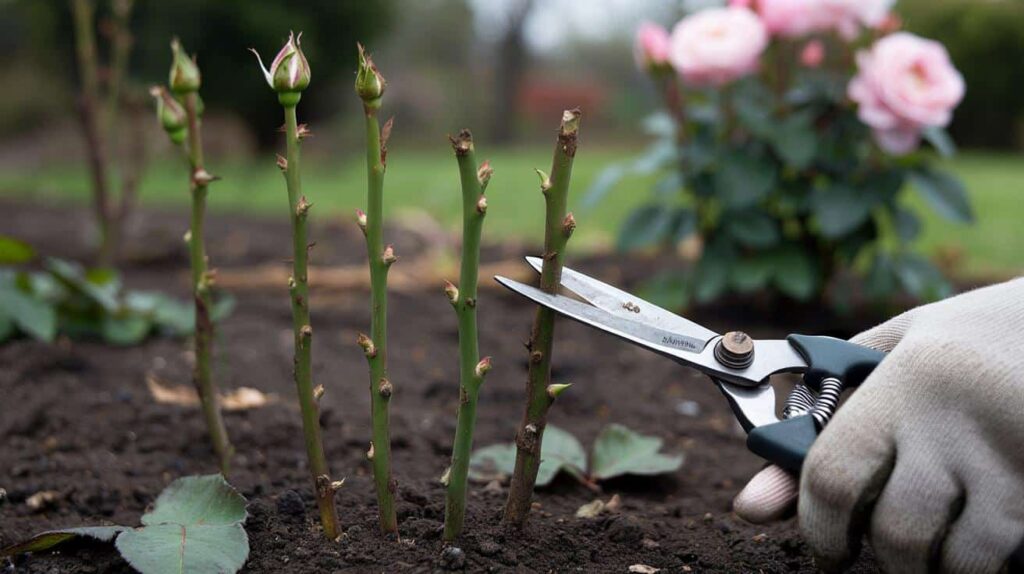
The crucial detail is the small swellings along the shoots. Gardeners call them „eyes“. Each eye is a potential shoot and therefore a possible flowering plant.
The most important step before every cut: calmly observe and count. Don’t prune by feel, but plan carefully how many buds should remain on each shoot.
How many eyes are ideal?
- Strong, healthy shoots: Leave 3 to 5 buds from the base.
- Weaker shoots: leave 2 to 3 buds.
- Very thin, diseased, or inward-growing shoots: remove them completely.
This keeps the inside of the bush more airy, allows leaves to dry faster after rain, and makes it much harder for fungal diseases to take hold.
What type of rose is growing there?
Before you reach for the shears, it’s worth doing a quick check: What type of rose is growing in the flower bed? Not every rose tolerates the same pruning in March.

Repeat-flowering and once-flowering roses
Roses can be roughly divided into two groups:
- Repeat-flowering roses: These bloom several times a year. Their main pruning takes place at the end of winter, i.e., in late February or March, depending on the region.
- Once-blooming roses: These roses only produce flowers once a year, usually in early summer. These varieties develop their flowers on the previous year’s wood. A heavy pruning in March would remove almost all the flower buds.
How to properly train climbing roses instead of pruning them
Climbing roses often give many amateur gardeners a headache. The key here is structure, not prune. Repeat-flowering climbing roses, in particular, benefit from a clear, structured form.
- Select 3 to 5 strong, well-lignified main shoots and attach them to the trellis.
- Arrange these main shoots horizontally or in a fan shape to encourage the formation of many side branches.
- Shorten the lateral shoots to 2 to 3 buds, again just above an outward-facing bud.
Typical mistakes when pruning roses in March
- Cutting everything to the same height results in a „broom“ of equally long stumps, instead of a harmonious shrub shape.
- If you cut too close together in the center, the middle remains full, the air circulation is poor, and mushrooms thrive.
- Completely remove old wood – especially in older roses, fruiting shoots with many flower buds are then missing.
- Avoid cutting in frost or wet conditions – cuts heal less well, and infections increase.
- Using blunt or dirty scissors results in bruising instead of clean cuts and increases susceptibility to disease.
Preparation: Protect roses when pruning
- Clean the scissors and disinfect them if necessary.
- Make sure the blades are sharp so that the cuts are smooth.
- Wear gloves to protect yourself from thorns.
- Remove heavily aged, grey wood first, starting at the base.
More flowers with the right combination of pruning and care
Pruning alone doesn’t determine the abundance of blooms. However, it works in conjunction with other aspects of rose care. After a well-planned pruning in March, a moderate starter fertilizer is beneficial, ideally a special rose fertilizer with a high potassium and phosphorus content. These nutrients support bud formation and flowering.
Consistent watering is also helpful. Extreme waterlogging from above, for example from constantly watering with a hose, promotes fungal growth and leaches nutrients. It’s better to water directly at the root zone and keep the foliage as dry as possible.

Anyone who combines all these points with the simple rule of thumb will quickly realize: March is not a month for blind pruning, but for a calm, careful look. A few extra minutes of attention to each shoot will pay off in summer with significantly more blooms – and that’s precisely why it’s worth using the shears less often when in doubt.