The vegetable garden really gets going in April, the seed potatoes are ready – and many people are wondering: should I plant them now, or wait, how deep, how often? Those who are half-hearted about this can quickly lose two weeks of harvest time and risk ending up with puny tubers. This can be avoided with a few well-placed steps.
Why April determines the potato harvest
In April, the weather fluctuates greatly: a few warm days, then ground frost, accompanied by unpredictable rain. It is precisely during this phase that potatoes lay the foundation for roots, shoots, and later tuber formation. Those who proceed systematically now conserve water, protect the plants from frost damage, and bring the harvest forward by up to two weeks.
Five simple but consistently implemented measures transform average potatoes into strong plants with stable yields.

The core idea: well-prepared tubers, loose, suitable soil, the right time, a single, thorough watering, and then a thick layer of mulch. What sounds unspectacular works like a turbocharger in the garden bed.

Step 1: Properly pre-sprout seed potatoes
It’s worth taking a close look at the tubers as early as the beginning of the month. Ideal pre-sprouts have short, strong shoots, usually dark green to purple. Long, thin, pale shoots indicate that the tubers were stored in too dark or too warm a location.
- Place tubers in a single layer in shallow boxes, in a bright but frost-free location.
- Aim for a temperature of around 10 to 15 degrees, no direct sunlight.
- If there are too many shoots on one tuber, cut them back to two or three – this will produce fewer, but larger potatoes.
Those who skip the pre-sprouting phase can still plant, but must expect a 10 to 14 day delay until harvest. Anyone planning to grow early potatoes for cooking will notice this significant time loss.
Step 2: Prepare the floor thoroughly
Before planting, the area should be prepared as carefully as a flower bed. This will save you trouble later with crooked tubers and sickly plants.
- Remove weeds, stones, and soil structure.
- Loosen the soil deeply and break up any large clumps.
- Potatoes thrive particularly well in slightly acidic soil.
- Aim for a pH value between 5.5 and 6.5.
- Use mature compost as a starter fertilizer.
Step 3: Finding the right time in April
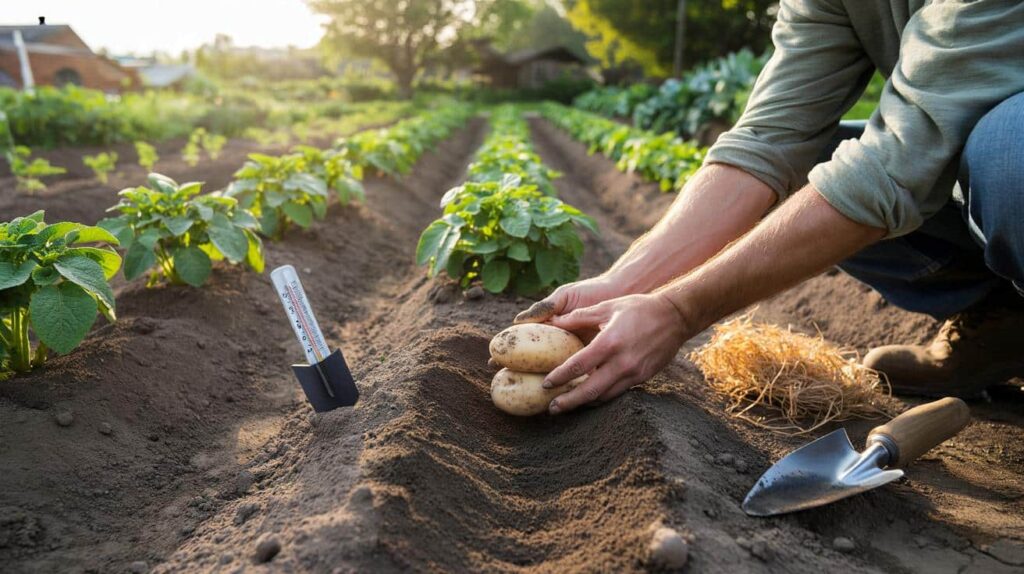
The calendar week is less important than the soil temperature. As a rule of thumb: at a depth of 10 centimeters, the temperature should be at least 8 to 10 degrees Celsius, and the soil should not feel wet and icy cold.
In milder regions, planting season often begins as early as the beginning of April. In cooler areas, the optimal time is more likely to be between the middle and end of the month, once severe frosts become less probable.
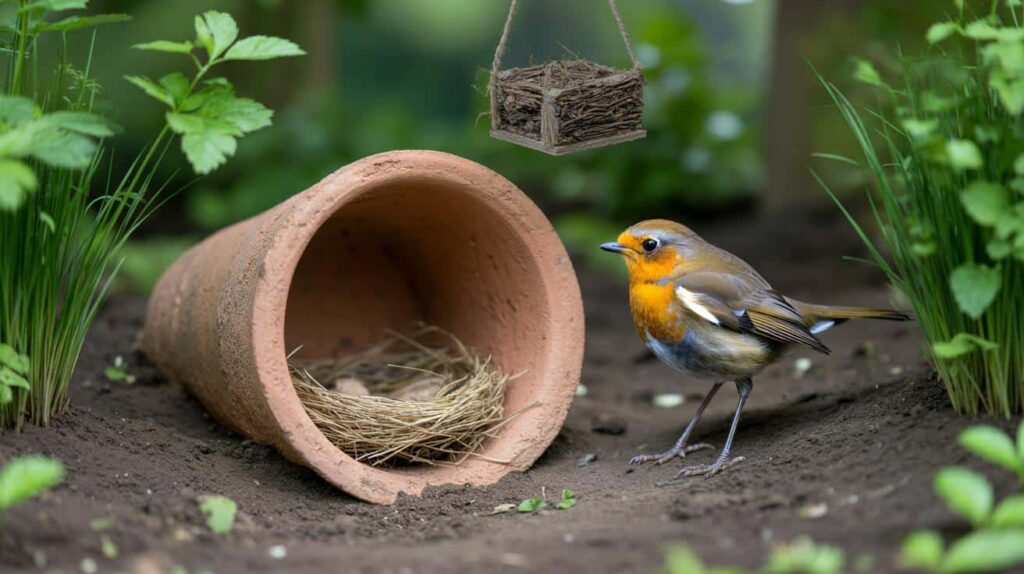
 Rotkehlchen im Garten profitieren oft mehr von einem Tontopf als von einem klassischen Nistkasten
Step 4: Depth, spacing and planting technique
Once the timing is set, the actual planting begins. This is where it’s decided whether the plants will later crowd each other or whether there will be enough space for tuber formation.
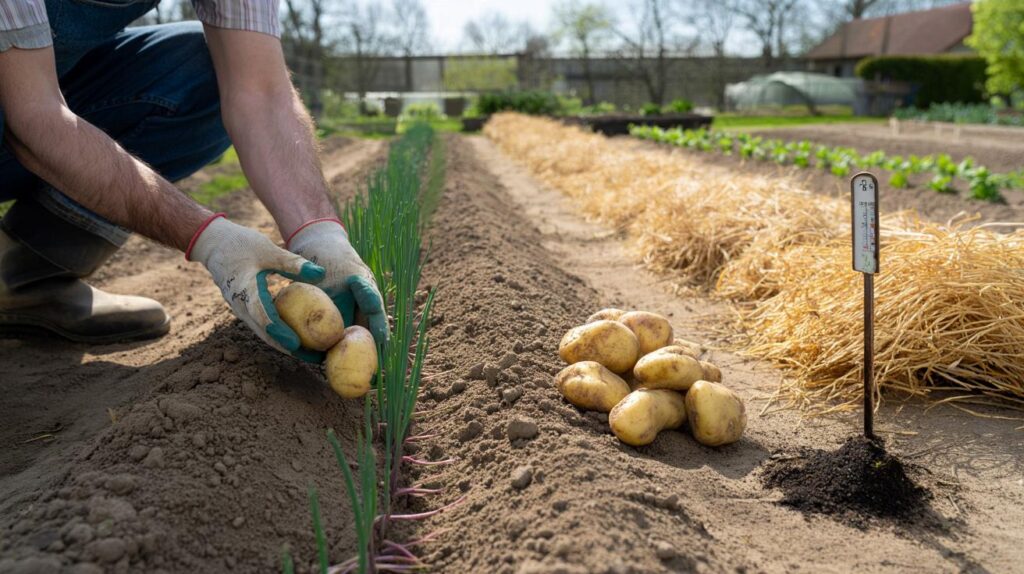
- Row spacing: 60 to 70 centimeters.
- Planting distance within the row: 30 to 40 centimeters.
- Planting depth: 10 to 15 centimeters.
Those who only have a balcony or terrace can surprisingly grow potatoes very well in containers. Important points:
- Container size: approx. 40 liters for 3-4 tubers, substrate depth at least 30-40 cm.
- Container size: approx. 20 liters for 2 tubers, substrate depth approx. 30 cm.
Step 5: Water thoroughly once, then mulch.
Immediately after planting comes perhaps the most important step of the entire season: a thorough watering. Approximately 10 liters of water per square meter is sufficient to deeply moisten the root zone.
Immediately afterwards, a thick layer of mulch, about 15 centimeters high, is applied to the area. Suitable materials include:
- Clean straw bales.
- Hay without problem weeds.
- Dried, shredded plant remains.
Mulch slows down evaporation, keeps the soil cooler and moister, and protects it from heavy rain. If you lift the mulch occasionally and find fresh, slightly damp soil underneath, you can postpone watering for significantly longer than many people think.
Mistakes that cost revenue in April
- Place tubers in wet, cold soil.
- Too little space, causing the plants to shade each other.
- Excessive nitrogen application, which only promotes leaf mass.
- Frequent, shallow watering instead of infrequent deep watering.
- Lack of mulch, which causes the soil to dry out.
Helpful background information for hobby gardeners
Many people wonder why pH value plays such a role. In slightly acidic soils, certain nutrients are more readily available, while at the same time some pathogens thrive less well. This reduces the risk of scab, for example.

The roots grow towards the water. If the moisture level is lower, the plants also root deeper and can cope with longer periods of drought.